Learn a language
ten words at a time.
Real sentences, not lonely flashcards. You fill in each word like a crossword, and FSRS spaced repetition brings it back right before you'd forget it.
Three steps, ten words at a time
No decks to build, no settings to tune. Open the app and start with the words that matter most.
Pick your language
Choose the language you're learning. A quick placement drops you in at the right level — beginners start with the most common words.
Solve today's ten
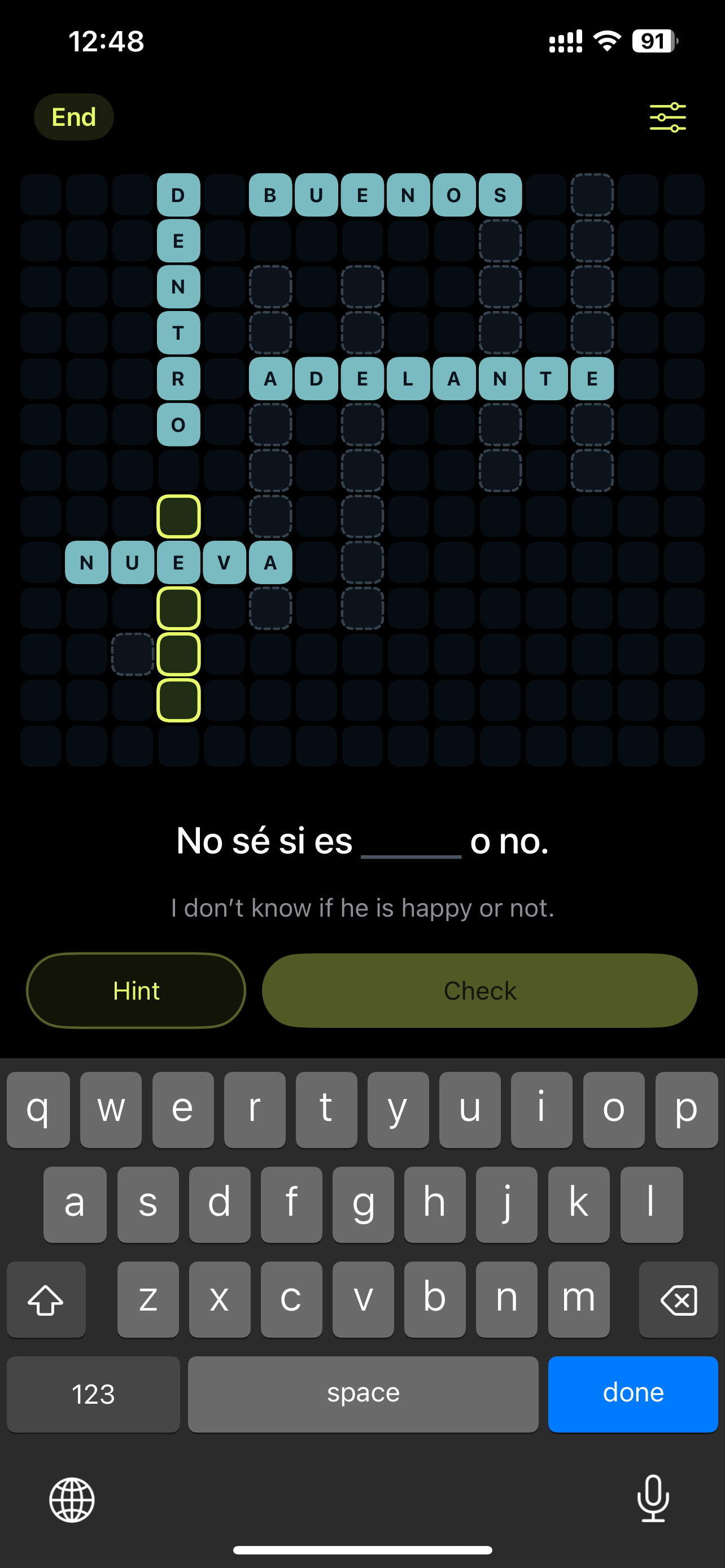
Each word appears in a real sentence with its translation. Type it into the crossword to lock the meaning, spelling and usage in together.
Let FSRS do the rest
Spaced repetition schedules each word to come back right before you'd forget it — so today's ten actually stay with you.
Built to make words stick
Spaced repetition
Reviews land at the perfect moment — not too early, not too late — so you remember with far less effort than cramming.
Words in context
Every word lives inside a natural sentence, so you learn how it's really used — meaning, grammar and collocation at once.
High-frequency first
Words are ordered by how often they're actually used, so early effort buys the most understanding.
Learn the method behind the app
Short, practical guides to spaced repetition, learning in context, and getting fluent faster.
How to learn Spanish vocabulary (and remember it)
The fastest honest way to build a Spanish vocabulary that sticks.
Read guide → MethodWhat is spaced repetition?
Why timing your reviews beats re-reading, and how to use it.
Read guide → MethodFSRS explained
The modern spaced-repetition algorithm — and why it beats SM-2.
Read guide → MethodCloze deletion & fill-in-the-blank
Why completing sentences teaches vocabulary better than flipping cards.
Read guide → MethodLearn vocabulary in context
How example sentences turn words you recognise into words you can use.
Read guide → FluencyThe most common Spanish words
How many words you really need — and which ones to learn first.
Read guide →Does 10 Words use spaced repetition?
Yes. Every word is scheduled with FSRS (Free Spaced Repetition Scheduler), a modern open-source algorithm. It tracks how your memory of each word fades and brings the word back at the moment you're about to forget it — not too early, not too late.
What is FSRS and why does it matter?
FSRS models your personal memory instead of applying one fixed schedule to everyone. In large benchmarks it needs roughly 20–30% fewer reviews than the older SM-2 algorithm for the same retention — so you remember more in less time.
Is 10 Words like Anki or Clozemaster?
It shares their best ideas — cloze (fill-in-the-blank) sentences and spaced repetition — but with modern FSRS scheduling, a crossword you actually play, ready decks ordered by frequency, and a calm ten-words-at-a-time pace. No deck-building required.
What languages can I learn?
Pick from a growing set of languages — including Spanish, French, German, Italian and Portuguese, with more added over time. Every course uses the same in-context, spaced-repetition method.
Why learn words in sentences instead of flashcards?
A flashcard teaches a translation; a sentence teaches usage. Because 10 Words shows every word inside a real sentence, you pick up meaning, grammar and the words it naturally pairs with — the difference between recognising a word and being able to use it.
How many words do I need to be fluent?
The most common 1,000 words cover about 88% of everyday speech, and 2,000–3,000 gets you comfortable conversation. Because 10 Words teaches the highest-frequency words first, your early effort covers the most ground.
Where do the sentences come from?
Many sentences and translations come from Tatoeba, a free, community-built database released under a Creative Commons licence. We filter for quality, and you can flag any card that looks off.
Is it free? Is there an Android version?
You can start learning for free. 10 Words is available on the App Store for iPhone; Android is planned later.
Ten words at a time. That's the whole idea.
Start with the words that matter most, learn them in real sentences, and let spaced repetition keep them. New languages are added over time.